
Lessons Learned from Adaptation Interventions in 13 Gewogs, Experiences from Paro, Tsirang, and Dagana Dzongkhags.
Bringing together voices, best practices, and experiences from the communities who are implementing this project and working closely with beneficiaries, where the results are seen and felt on the ground.
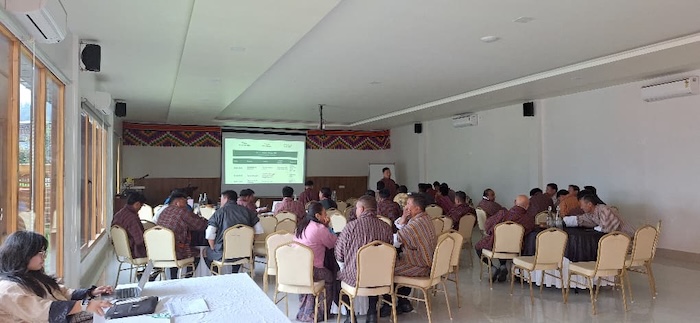
From 29–30 June 2026, BTF brought together 55 participants who have shaped our water and climate adaptation project from the very beginning, project focals, local governments, and the newly formed Water User Associations (WUAs), for a two-day Knowledge & Experience Sharing Workshop.
This workshop is part of “Adaptation to Climate-Induced Water Stresses through Integrated Landscape Management in Bhutan,” an Adaptation Fund project implemented by BTF across Dagana, Paro, and Tsirang Dzongkhags, covering 13 gewogs and reaching over 36,000 people who face growing water stress, drying water sources, and climate-related disaster risk.
Local leaders, Gup, Tshogpa, and Mangmi, joined to capture lessons learned across planning, design, and implementation, and to document them for future iterations of this work.
Throughout the workshop, participants heard and reviewed the full range of experiences and lessons available, including insights from past projects, and gathered perspectives directly from project stakeholders to better understand specific approaches, their effectiveness, and the lessons learned from implementation on the ground.
Empowering local stakeholders to lead climate adaptation gives communities on the frontlines of climate impacts a real voice in decisions that shape their lives and livelihoods. Climate adaptation works best when those closest to the problem lead the response, they understand it best and can solve it faster.
The workshop also introduced Payment for Ecosystem Services (PES) and other sustainability mechanisms, drawing on lessons from an established scheme in Paro, under the Critical Watershed Management of the Richulum Watershed project, supported by BTF to the Dhopshari Gewog Administration, a model already running successfully in Paro.
Our goal is inclusive, participatory adaptation, where development activities are shaped by the very communities they serve, and where results are seen and felt on the ground. Through this workshop, we aim to retain institutional knowledge, support our newly formed WUAs as they find their footing, and put the poorest and most climate-vulnerable communities at the center of development.
Participants from the grassroots expressed their gratitude for the opportunity, noting that local community participation shifts decision-making and resources directly to the communities most impacted by climate risks. It empowers marginalized stakeholders to take on leadership roles in planning and resource management, and strengthens institutions by focusing on how local and national systems actually work, rather than how they are formally designed. By working through existing coordination mechanisms, adaptation strategies gain legitimacy and continuity. Participants also emphasized that iterative learning recognizes adaptation as a continuous, evolving process, with knowledge sharing spanning the entire project cycle through education, technical training, networking, and public awareness campaigns.